
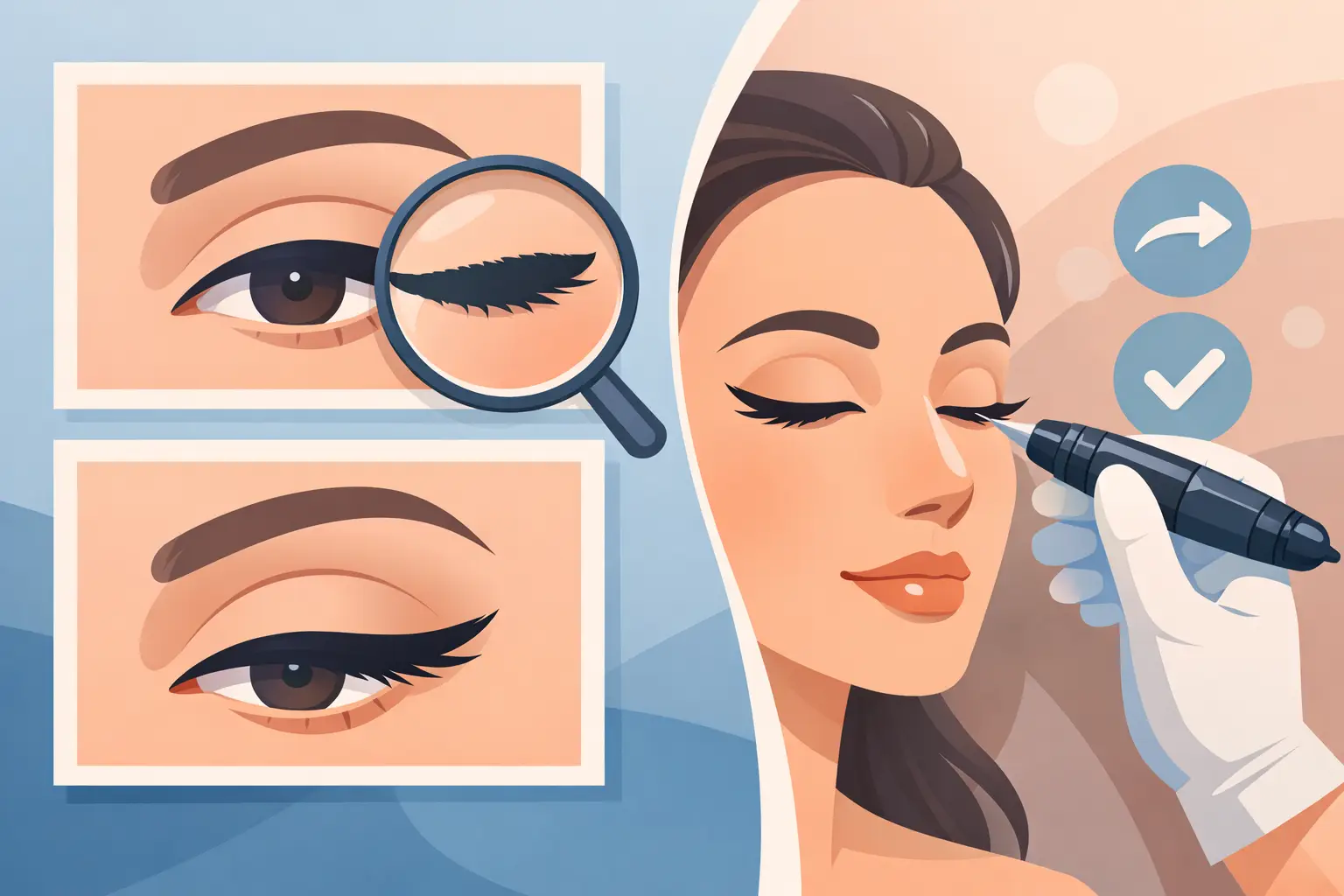
One eye looks lifted, the other looks heavier. The line may be thicker on one side, the tails may sit at different angles, or the pigment may have healed darker on one lid than the other. If you are searching for how to correct uneven eyeliner tattoo, the first thing to know is that unevenness is often fixable – but the right correction depends on why it happened.
Eyeliner correction is not a one-size-fits-all service. The eye area is delicate, highly visible, and constantly in motion. A result that looks only slightly off in a photo can feel major in real life because even small asymmetries around the eyes change the entire expression of the face. That is why correction should be approached with the same precision as the original procedure, and often with even more restraint.
How to correct uneven eyeliner tattoo depends on the type of unevenness
Some eyeliner tattoos are uneven in shape. Others are uneven in saturation, where one side appears darker, denser, or cooler in tone. In some cases, the placement itself is the issue. A line may sit too high above the lash line on one eye, or the wing may follow a direction that does not suit the natural anatomy.
This distinction matters because shape problems and color problems are corrected differently. If one liner is simply lighter, additional pigment may be enough. If one side is thicker, lower, or longer, adding more tattoo to the opposite side can create balance, but only to a point. Beyond that point, removal or lightening may be the cleaner solution.
The most sophisticated corrections are designed around the face as it exists now, not around the original intention. Eyelids are naturally asymmetrical. Most people have one brow slightly higher, one eye more hooded, or one lid with more visible space. An experienced corrective artist evaluates whether the tattoo is uneven, whether the anatomy is uneven, or whether both are contributing to the result.
Common reasons eyeliner tattoos heal unevenly
A technically weak application is one cause, but it is not the only one. Eyeliner can heal unevenly because the skin on each eyelid is not identical. Oily skin, mature skin, hooded lids, prior scar tissue, pigment migration, and inconsistent depth all affect retention. Healing aftercare also plays a role.
Sometimes the original design was mapped with the eyes closed and looked acceptable on the treatment bed, then appeared imbalanced once the face was fully animated. That is one reason premium correction work requires careful assessment with the eyes open, relaxed, and in motion.
Start with a proper correction assessment
The safest way to approach an uneven eyeliner tattoo is to resist the urge to fix it too quickly. Fresh work can soften during healing, and what looks dramatically uneven at first may settle. In general, the area should be fully healed before any meaningful correction plan is made.
A proper assessment looks at more than symmetry alone. The artist should evaluate pigment color, edge sharpness, line thickness, healed saturation, scar tissue, eyelid elasticity, and how the tattoo sits against your lash line. They should also ask what you want the final result to feel like. Some clients want a polished visible liner. Others want a barely-there enhancement that simply makes the lashes appear fuller.
That difference matters because the correction strategy changes. If your goal is softer and more natural, adding bolder tattoo to force symmetry may solve one problem while creating another.
When waiting is the right decision
If your eyeliner tattoo is less than six to eight weeks old, waiting may be the smartest move unless there is a clear complication. Pigment can contract, soften, and lighten during healing. Mild swelling can temporarily distort symmetry. One side may also heal slower than the other.
Correction performed too early can stack pigment into tissue that is still recovering. Around the eyes, that is rarely the premium solution.
Correction options for uneven eyeliner tattoo
The right treatment usually falls into one of three categories: refinement, balancing, or removal-based correction.
Refinement means improving edge quality, smoothing patchiness, and restoring a cleaner shape without significantly increasing thickness. This is ideal when the original tattoo is close to correct but needs precision.
Balancing means carefully adding pigment to the lighter or smaller side so both eyes read more evenly. This can work well when asymmetry is subtle and the existing design still suits the face.
Removal-based correction is often the best option when one liner is too thick, too extended, poorly placed, migrated, or healed into a color that no longer looks refined. In those cases, adding more pigment to chase symmetry can make the eyeliner heavier and less elegant. Strategic lightening creates room for a more sophisticated redesign.
Why adding more is not always better
Clients are often told that uneven eyeliner can simply be made even by thickening the other side. Sometimes that is true. Often it is not. Eyeliner sits in one of the most unforgiving areas of the face. If one side is already too heavy, matching it on the other eye may create symmetry but still leave you with a result that looks harsh.
The better question is not, “How do we make both sides equal?” It is, “How do we make both sides flattering?”
That is where correction becomes advanced work. It requires discipline, not just pigment.
How to correct uneven eyeliner tattoo without creating a harsher look
The most natural-looking corrections respect the eyelid’s anatomy. A specialist should account for lid fold, skin texture, eye openness, and facial balance before deciding where any additional pigment belongs. A line that appears thin on a stretched lid can look much thicker when the eye is open. A tiny wing adjustment can visually lift one eye or drag it down.
For that reason, conservative corrections usually produce the most elegant outcomes. Softening an overly obvious line, rebalancing saturation, and tightening placement closer to the lash line often look more refined than building a bolder shape.
This is also why correction around the eyes should not be approached like standard body tattoo correction. Cosmetic tattooing is aesthetic architecture. Millimeters matter.
Color correction may be part of the solution
Not every uneven eyeliner tattoo is uneven because of shape alone. If one eye healed blue-black and the other softened into a charcoal tone, the imbalance may be largely chromatic. Corrective pigment work can sometimes neutralize and rebalance the appearance, but only when the existing saturation level supports it.
Very dark, densely implanted eyeliner may need partial removal before color refinement is possible. Otherwise, the result can become muddy instead of crisp.
What to avoid when fixing uneven eyeliner
The worst corrections usually come from rushing, overbuilding, or choosing a provider who treats eyeliner as a routine touch-up instead of a corrective procedure. The eye area does not leave much room for experimentation.
Avoid seeking repeated touch-ups from multiple artists without a clear long-term plan. Layering different pigments, techniques, and design philosophies into the same thin strip of eyelid skin can make future correction harder. It can also increase the risk of scar tissue and unpredictable retention.
It is also wise to avoid judging the design only from a magnified mirror at one angle. Correction decisions should be based on how the eyeliner reads in normal light, at conversational distance, and with the face at rest.
Choosing the right specialist for eyeliner correction
Corrective eyeliner requires more than basic permanent makeup training. You want someone who understands healed results, not just fresh results. They should be able to explain whether your case needs subtle balancing, shape redesign, or pigment reduction first. They should also be transparent about trade-offs.
Some uneven eyeliner tattoos can be corrected in one session. Others need staged treatment. If the original tattoo is significantly too thick or asymmetrical, the most beautiful result may come from patience rather than speed.
At the premium level, correction is about creating an outcome that does not read as correction. It should simply look right. Soft. Balanced. Intentional. For clients who value discretion and natural refinement, that standard matters.
A clinic like MicroArt approaches correction with that philosophy in mind – not as a quick cover-up, but as a precision-based redesign built around facial harmony and long-term appearance.
What results can you realistically expect?
Most clients can achieve a meaningful improvement, but perfection is not always the right benchmark. Natural eyes are not perfectly symmetrical, and the goal of correction is usually visual harmony rather than mathematical sameness.
If the eyeliner is mildly uneven, results can be excellent with careful rebalancing. If the original work is very dark, thick, or misplaced, a staged process may be needed to restore softness and control. The more conservative the correction plan, the more believable the final result tends to be.
If your eyeliner tattoo makes one eye look heavier, sharper, or simply not like you, the answer is rarely more drama. The answer is precision, restraint, and a correction strategy built for the eye area – because the best eyeliner should frame the eye, not compete with it.