
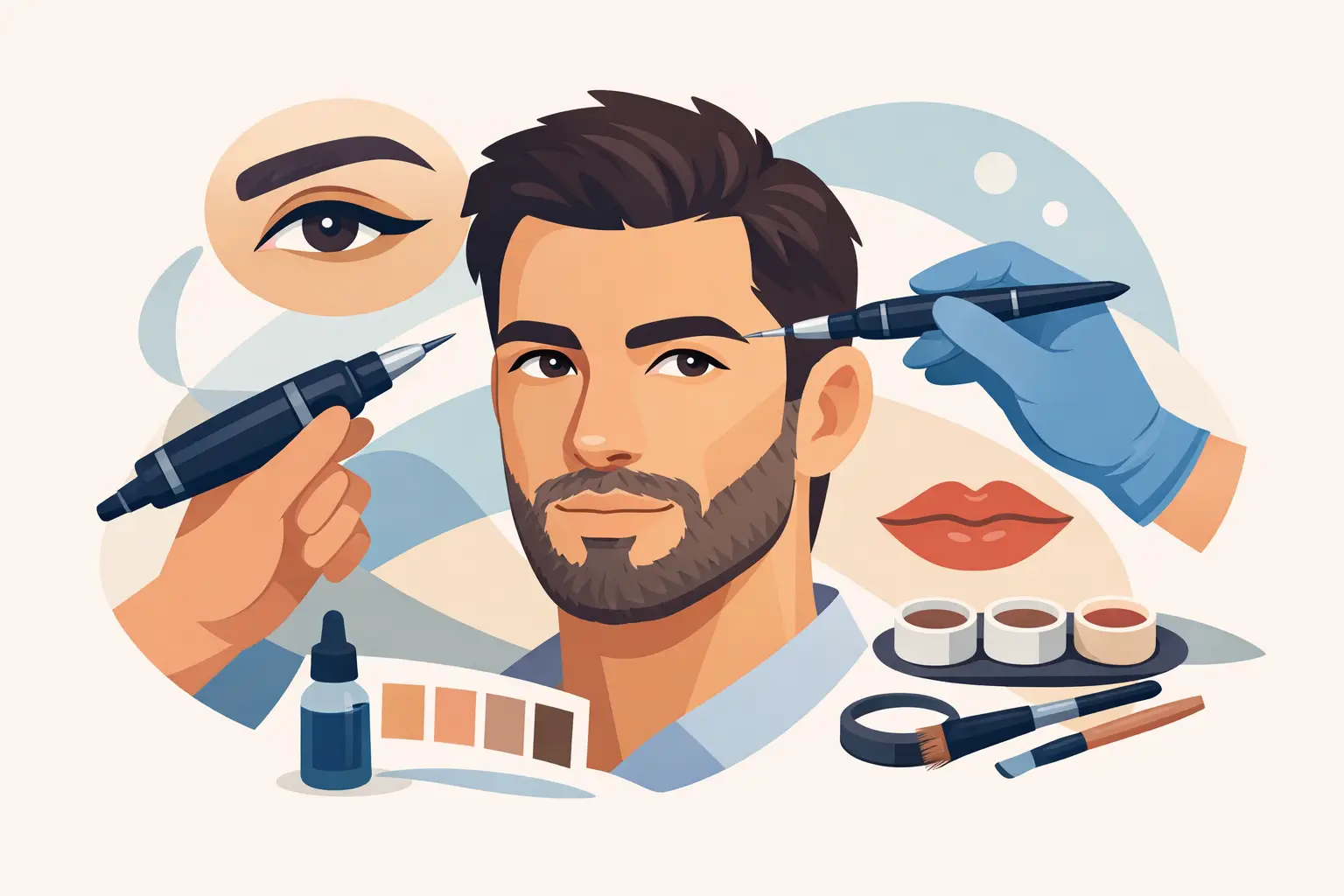
A harsh brow tattoo, an obvious hairline fill, or eyeliner that reads as makeup instead of definition – this is exactly what most male clients want to avoid. When people search for the best permanent makeup for men, they are rarely looking for a dramatic transformation. They want refinement that is invisible to everyone else and immediately noticeable to them in the mirror.
That distinction matters. Men typically do not want permanent makeup that looks styled, glossy, or overly shaped. They want features restored, balanced, and strengthened in a way that still looks like their own face. The best work is not the most visible work. It is the work no one can identify.
What makes the best permanent makeup for men different
Permanent makeup for men is not simply standard cosmetic tattooing with a lighter hand. The design approach, pigment choices, and technical execution should be completely different. Male clients usually need structure without softness, correction without cosmetic shine, and density without obvious edges.
A good provider understands male facial anatomy and grooming goals. A great provider understands restraint. That means avoiding over-arched brows, saturated color blocks, and any pigment placement that creates a makeup effect under daylight, office lighting, or close social distance.
This is where the trade-off becomes clear. Traditional tattoo methods can deposit color deeply and heavily, which may create a stronger immediate result, but they also raise the risk of hard edges, color shifting, and a finish that reads artificial. For men, that risk is especially high because even subtle cosmetic changes are more noticeable when the goal is undetectable enhancement.
The best permanent makeup for men usually solves one of five concerns
Most male clients are not looking for a menu of beauty treatments. They are trying to solve a very specific problem that has become frustrating, time-consuming, or confidence affecting.
Brows that look sparse, uneven, or faded
Eyebrows are one of the most common concerns. Men may lose fullness through age, overgrooming, stress, thyroid changes, alopecia, or simple genetics. The right brow enhancement restores density and definition without creating a sculpted shape.
The ideal result is subtle reinforcement of the natural brow pattern. In premium clinical settings, this often means custom pigment placement that mimics depth and shadow rather than obvious tattoo strokes. For men, the shape should stay flatter, stronger, and more anatomically believable than the highly stylized brow trends often marketed elsewhere.
Scalp shading for thinning hair or receding areas
Scalp work is often one of the most effective options for men because it can visually reduce the contrast between hair and scalp. When executed properly, scalp shading can make thinning areas look denser and a receding hairline appear more balanced.
This category requires precision. If the pigment is too dark, too cool, too large in pattern, or placed with a uniform stamped look, the result can appear artificial. The best treatment creates a soft illusion of density rather than a drawn-on hairline. It should account for existing hair color, skin tone, follicle pattern, and how the hairline should age over time.
Scar camouflage
Men often seek treatment for scars on the scalp, face, beard area, or body after surgery, injury, or hair transplant procedures. Scar camouflage can soften the visual contrast so the scar does not catch the eye first.
This is highly case dependent. Some scars respond beautifully, while others need a more gradual plan depending on texture, coloration, and healing history. A realistic consultation should address that upfront. The best provider will not promise identical surrounding skin on every case. They will focus on strategic improvement and natural blending.
Beard gap correction
Some men have patchy beard growth that creates unevenness along the cheeks, mustache, or jawline. In select cases, pigment can be used to add the appearance of depth in sparse areas.
This is one of the easiest treatments to get wrong. The face is seen at close range, and the beard area has movement, texture, and changing shave habits. Technique must be exceptionally refined. The goal is not to draw a beard on. It is to reduce the contrast between fuller and thinner sections so the facial hair looks naturally more consistent.
Eyelash enhancement or subtle liner definition
This is less common but highly effective when done conservatively. Men who want their eyes to appear more defined, less tired, or more symmetrical may benefit from a very understated lash enhancement.
The keyword is understated. The best result sits in the lash line and disappears into the anatomy of the eye. Anything thicker or decorative will usually feel wrong for a male client seeking natural definition.
Why traditional permanent makeup is often the wrong fit
The biggest mistake in this category is assuming all permanent makeup is equal. It is not. Traditional methods were often built around visible cosmetic enhancement. That can work for clients who want a makeup look. It is rarely the right answer for men who want no one to know they had anything done.
Older techniques may rely on deeper implantation, pre-mixed pigments, or tools that do not allow the same level of fine control. That can lead to bruising, scabbing, prolonged healing, and color changes that become obvious over time. Brows can turn too ashy or too warm. Hairline work can flatten into a solid band. Scar camouflage can look disconnected from the surrounding skin.
For men, these issues are magnified because the margin for error is smaller. A subtle female brow can still read as intentional beauty styling. A male brow that looks shaped, filled, or tinted usually reads as a bad decision.
What to look for if you want the best permanent makeup for men
The first standard is naturalism. Not marketing language about natural results, but actual work that is difficult to detect even in close-up photos and different lighting. Ask whether the provider has strong experience with male clients specifically. A beautiful portfolio of women does not automatically translate to expertise in male enhancement.
The second standard is customization. Men span a wide range of skin tones, hair colors, textures, and aesthetic goals. A one-size-fits-all approach is the opposite of premium treatment. Pigments should be custom blended, and the design should reflect your existing anatomy rather than a trend template.
The third is healing profile. Downtime matters for male clients who often want discretion at work, in social settings, and while traveling. If a method commonly causes visible scabbing, heavy redness, or obvious post-treatment changes, that should factor into your decision.
The fourth is correction capability. A provider who can create sophisticated natural work should also understand how to assess previous tattooing, discoloration, or asymmetry. That level of skill usually reflects a deeper command of pigment behavior and skin response.
Clinics that specialize in advanced semi-permanent and camouflage work, including proprietary methods such as those developed by MicroArt, tend to stand apart here because the emphasis is on precision, low-trauma application, and highly individualized color matching rather than standard tattoo logic.
The consultation matters as much as the procedure
Men often come in with a simple question – what should I do? The right answer depends on whether the issue is loss of density, asymmetry, discoloration, scarring, or a previous procedure that needs correction.
A high-level consultation should evaluate your face as a whole, not just the feature you are focused on. Brows influence eye structure. Hairline design affects perceived age and facial balance. Scar blending must account for surrounding skin tone, texture, and visibility at distance versus close range.
This is also where realistic expectations are set. The best permanent makeup for men does not look like obvious enhancement on day one or a dramatic before-and-after on social media. The best result looks appropriate in a boardroom, under direct sunlight, at the gym, and six months later.
Who is a strong candidate
The strongest candidates are men who want discreet improvement, not cosmetic transformation. They are usually drawn to permanent makeup because they are tired of compensating for a concern every day, whether that means filling in a patchy beard, styling around thinning hair, or noticing asymmetry every time they look in the mirror.
They also tend to value convenience. If you travel frequently, maintain a public-facing career, or simply do not want a daily routine built around concealing something, a refined semi-permanent solution can be worth far more than the cheapest available treatment.
That said, not every concern should be treated with pigment immediately. Some skin conditions, scar types, or prior tattoo complications require a phased approach. A trustworthy clinic will tell you when to wait, when to correct first, and when another treatment may complement the result.
The best permanent makeup for men should never announce itself. It should restore what time, genetics, or injury took away and do it with enough precision that the result feels like you, only sharper, healthier, and more at ease. If the work is obvious, it is not the best. If it disappears into your features and gives you one less thing to think about each morning, that is where real quality begins.