
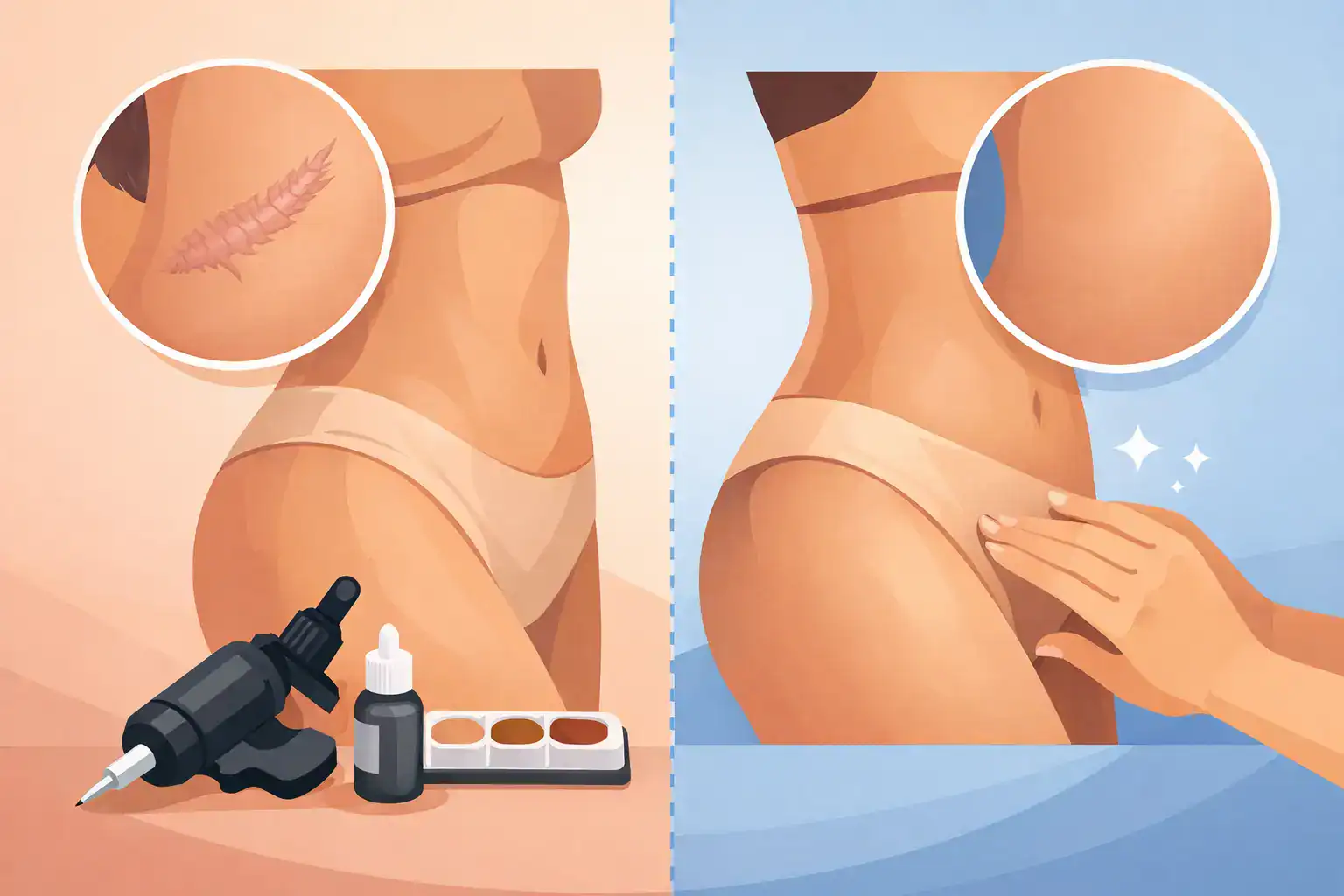
A scar can be flat, healed, and medically closed – and still pull focus every time you look in the mirror. That is why so many clients search for scar camouflage tattoo before after photos. They are not looking for a trend. They are trying to answer a high-stakes question: can this really make a scar blend naturally with the surrounding skin, or will it trade one visible issue for another?
The honest answer is that before-and-after results can be remarkable, but they are not automatic. Scar camouflage is a highly technical corrective procedure. The quality of the result depends on the age and type of scar, the skin’s undertone, the pigment strategy, the equipment used, and the provider’s ability to work with texture rather than pretend texture does not matter. When done with precision, the scar stops dominating the eye. It does not need to disappear completely to look dramatically better.
What scar camouflage tattoo before after really shows
The most useful before-and-after images do more than show a lighter patch turned closer to skin tone. They show whether the result holds up in real life. A strong outcome looks believable in daylight, at conversational distance, and without heavy makeup layered on top.
This matters because scar camouflage is not standard body tattooing. The goal is not to deposit obvious color. The goal is to custom-blend pigment so the scar recedes visually into the surrounding skin. That is a very different standard. A result can look impressive in a tightly cropped photo and still read as makeup, flat color, or mismatched undertone in person.
A true before-and-after transformation also accounts for healing. Fresh results often appear more visible right after treatment because the skin has been stimulated. The healed result is what matters. Premium camouflage work is judged over time – how the color settles, how naturally it fades, and whether the treated area continues to match the untreated skin as the complexion shifts slightly with season, skincare, and sun exposure.
Why some scars photograph beautifully after treatment and others do not
Not every scar is a candidate, and this is where experienced assessment separates premium corrective work from overly optimistic promises. The best results usually come from scars that are lighter than the surrounding skin, fully healed, and relatively stable in texture. If a scar is still pink, purple, raised, itchy, or changing, it is not ready.
Texture is another factor clients often underestimate. Camouflage can improve the appearance of color contrast, but it does not erase indentations or raised tissue. If the scar catches light because of a textural change, that difference may still be visible after treatment. In many cases, reducing the color contrast makes the texture far less noticeable. But the right expectation is blending, not airbrushing.
Location also affects outcomes. A scar on the abdomen, breast, scalp, or body may behave differently than one on the face. Areas with more movement, friction, or sun exposure can heal differently and may need more careful maintenance. Skin tone complexity matters too. The richer and more nuanced the natural skin color, the more advanced the color-matching process needs to be.
The best candidates for scar camouflage
Candidates with the strongest potential before-and-after improvement usually have mature scars that are at least one year old, have little to no active redness, and are lighter than the surrounding skin. They also have realistic expectations about what camouflage can and cannot do.
That last point is not minor. Clients who expect the scar to vanish completely are often disappointed, even with objectively excellent work. Clients who understand that the goal is natural visual harmony are much more likely to love the result.
The difference between natural camouflage and obvious tattooing
Many people hesitate because they associate tattooing with sharp outlines, color shifts, or pigment turning unnatural over time. That concern is valid. Traditional tattoo techniques and conventional permanent makeup methods are not designed for sophisticated scar blending.
Corrective camouflage requires custom color formulation, controlled implantation, and a method that respects fragile scar tissue. If the pigment sits too cool, too warm, too opaque, or too dense, the treated area can become more noticeable instead of less. This is why technique matters as much as pigment.
At a specialist clinic level, the objective is not simply to put color into pale tissue. It is to create an effect that reads as skin, not cosmetic product. That means understanding undertone, translucency, healing behavior, and how scars reflect light. It also means knowing when not to treat.
Scar camouflage tattoo before after healing stages
One reason clients misread before-and-after galleries is timing. Immediate results are not final results. Right after treatment, the area can look more defined, darker, or slightly pink from the procedure itself. That does not mean the match is wrong.
Over the next several weeks, the color softens as the skin heals. Some scars retain pigment beautifully after the first session. Others need additional refinement because scar tissue can be unpredictable. This is normal. Corrective work is often a process, not a single appointment miracle.
The best providers plan for adjustment rather than overworking the skin on day one. Conservative layering tends to produce the most believable result. A rushed approach may look dramatic immediately but can create a heavy or unnatural finish once healed.
Why multiple sessions are often part of the best result
Scar tissue does not always accept pigment evenly. One section of the scar may hold more color than another. A second or third session can fine-tune balance, improve blend, and keep the result soft rather than saturated.
For clients reviewing scar camouflage tattoo before after examples, this is worth remembering. The most refined after photo may represent a completed treatment plan, not a single session. That is not a drawback. It is often a sign that the provider prioritized precision over speed.
What makes premium scar camouflage worth the investment
This category attracts clients who care deeply about natural results and discretion. They are not looking for the cheapest option. They are looking for work that can hold up under close scrutiny and blend into real life.
That is where premium methodology matters. Advanced cosmetic camouflage is part color science, part skin assessment, and part artistic restraint. Equipment quality affects how gently and precisely pigment is placed. Pigment quality affects how accurately skin tone can be matched and how gracefully the result ages. Experience affects everything.
A luxury corrective setting should also offer something else: proper screening. If a clinic says yes to every scar, that is not expertise. Strong specialists know when a scar needs more healing time, when another modality should come first, or when a client’s goals do not align with what camouflage can realistically achieve.
For that reason, many discerning clients choose founder-led or specialist-led providers with a proven focus on corrective aesthetics. In Beverly Hills, MicroArt has built its reputation around exactly this kind of natural-looking, highly customized camouflage work.
Questions to ask when reviewing before-and-after photos
The smartest way to evaluate results is to look beyond the headline transformation. Ask whether the before photo shows a fully healed scar and whether the after photo is immediate or healed. Notice if the lighting is consistent. Pay attention to whether the result looks believable across the full treated area or only from one angle.
It also helps to ask what changed and what did not. Did the scar blend better in color but still retain texture? Was the improvement subtle and elegant or dense and makeup-like? The best work usually looks understated in the best possible way. People notice the scar less, not the procedure more.
The emotional side of before and after
Scar camouflage is technical, but the reason people pursue it is personal. A scar may come from surgery, injury, childbirth, augmentation, gender-affirming care, self-harm recovery, or a medical event they would rather not revisit every day. Before-and-after results matter because they represent relief as much as refinement.
For some clients, the change is about confidence in fitted clothing, intimacy, or being photographed. For others, it is simply about no longer seeing one area before they see themselves. That is why expertise and discretion matter so much in this field. The procedure should feel considered, not transactional.
A beautiful result is not the loudest one. It is the one that lets your skin look more even, your scar attract less attention, and your focus return to everything else. If you are evaluating scar camouflage, look for healed results, honest expectations, and a provider sophisticated enough to know that natural always wins in the end.